

What is the Consumer Duty?
Today (31 July 2023) the Financial Conduct Authority (FCA) introduces a new Consumer Duty. This aims to make financial firms improve standards and put customers’ needs first. It should mean that they have to do more for customers and make it easier for them to complain. Companies must deliver “good outcomes” for customers and prevent “foreseeable harm”.
What the Consumer Duty involves
The new rules comprise, according to the FCA:
- “A new Consumer Principle that requires firms to act to deliver good outcomes for retail customers.
- Cross-cutting rules providing greater clarity on our expectations under the new Principle and helping firms interpret the four outcomes (see below).
- Rules relating to the four outcomes we want to see under the Consumer Duty. These represent key elements of the firm-consumer relationship which are instrumental in helping to drive good outcomes for customers.”
These outcomes relate to:
- products and services
- price and value
- consumer understanding
- consumer support
The Consumer Duty requires firms to “consider the needs, characteristics and objectives of their customers – including those with characteristics of vulnerability – and how they behave, at every stage of the customer journey. As well as acting to deliver good customer outcomes, firms will need to understand and evidence whether those outcomes are being met.”
Financial institutions will need to provide fair value with prices and quality of products and services that are also suitable. Consumers should expect good treatment and have a strong confidence and participation in accessing markets.
What you can expect from the Consumer Duty
The FCA says that customers can expect:
- “helpful and accessible customer support, so it’s as easy to sort out a problem, switch or cancel your product, as it was to buy it in the first place
- timely and clear information you can understand, so you can make good financial decisions. This means important information shouldn’t be buried in lengthy terms and conditions
- providers to offer products and services that are right for you, rather than pushing products and services you don’t need
- products and services to provide fair value. This should mean you won’t be ripped off or have to pay costs you didn’t expect. But while your provider should offer you a fair price, it doesn’t mean it will be the best deal for you, so you should still shop around
- firms to consider if you’re in a vulnerable situation when dealing with you. This could be due to poor health or financial troubles, for instance.”
The rules come into force on 31 July 2024 for “closed products or services” which are those which are no longer being sold by a financial services company. For example, a type of savings account or mortgage which is no longer available to new customers. Savings accounts and the Consumer Duty
Today, the FCA also announced a 14-point action plan on cash savings to “ensure banks and building societies are passing on interest rate rises to savers appropriately, that they’re communicating with customers much more effectively and offering them better savings rate deals.”
The regulator’s research showed that interest rates on saving accounts were rising but more slowly on those which were easy access. It also found significant variance between January 2022 and May 2023 and it discovered that, on average, nine of the biggest savings providers “only passed through 28% of the base rate rise to their easy access deposits.”
This compared with passing on 51% during the same period for notice and fixed term deposits. Still not even the full amount and yet so quick to pass on the full rate for mortgages!
Sheldon Mills, Executive Director of Consumers and Competition at the FCA, said:
“We want a competitive cash savings market that delivers better deals for savers, where interest rates are reviewed quickly following base rate changes and firms prompt savers to switch to accounts paying higher rates.
“We welcome the progress that has been made so far but this needs to speed up. We will be using the Consumer Duty to ensure this is the case – with firms required to prove to us that they are offering their customers fair value.“
It pays to shop around. Compare savings rates across accounts. Money Saving Expert has provided a detailed guide on Top Savings Accounts.
How the FCA will monitor the Consumer Duty
The FCA states that it will monitor key outcomes for consumers. It will be analysing the Financial Ombudsman’s decisions on complaints about fees, charges and or inappropriate product or service sales, whether consumers are getting products and services which meet their needs and provide fair value.
It is also going to monitor the products and services that consumers use, and measure what consumers are seeing and feeling and their levels of trust and confidence, including through its Financial Lives Survey. It will “evaluate the success of the proposals by using data from a variety of sources including supervision and authorisation activities, firm management information (MI) and complaints data.”
The FCA also says in the guidance above that as it implements the Duty, it will develop further metrics by which it can assess its impact at the level of particular sectors and portfolios, and will ask stakeholders for views and suggestions on potential metrics.
Reporting a breach of the Consumer Duty
If you feel that a financial institution has breached the Consumer Duty, complain to them. If you are not happy with the response then you can take the matter to the Financial Ombudsman.
Further help with financial issues
Top 20 Tips on how to complain effectively
How to complain about financial institutions – various posts about how to complain about banks, credit cards, insurance companies etc.

Save yourself time and effort finding the laws and wording a letter of complaint and download a template, fill in your details and get that redress
Purchase downloadable templates to gain redress
Templates for complaining about financial institutions
Further help with complaining effectively
Top 20 Tips on how to complain effectively
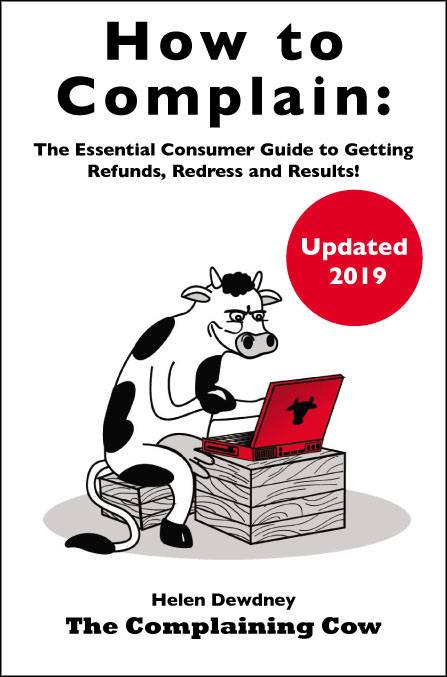 For masses of information, tips, guidance, laws and regulations and templates GET THE BOOK! How To Complain: The ESSENTIAL Consumer Guide to Getting REFUNDS, Redress and RESULTS!

Want to get better at complaining? See 101 Habits of an Effective Complainer
If, after hours of reading that little lot you still need help then please see How The Complaining Cow can complain for you!