
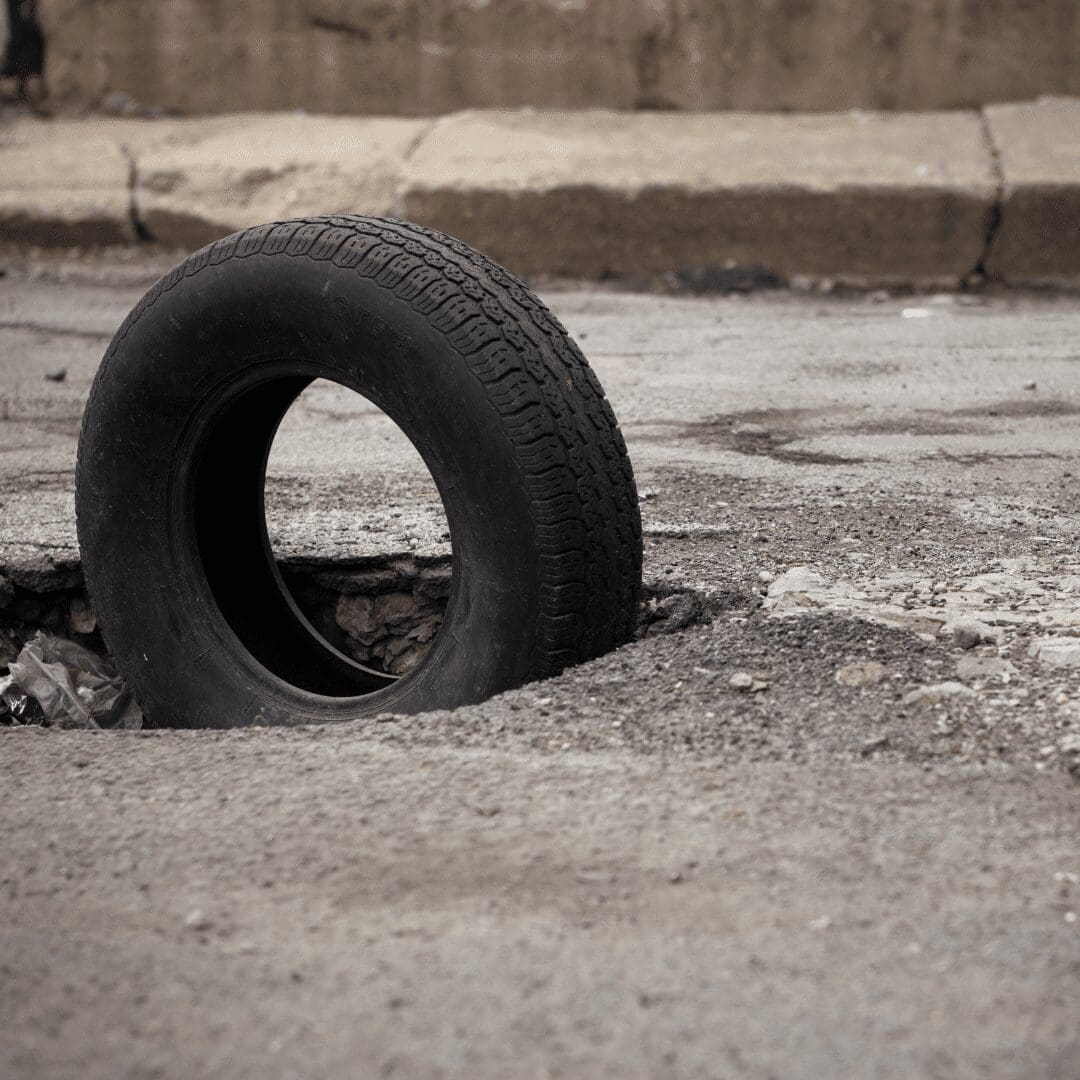
Pothole situation has worsened and real-terms funding decreased
Many road users have hit a pothole at some time in their life. The outcome can often be damage to their vehicle and resultant costs in time and to their pocket.
The cost of worsening carriageway conditions and under investment has been highlighted yet again today (17 January 2025) in a Public Accounts Committee report about the state of local roads in England. The PA News Agency reported that ‘Conservative MP Sir Geoffrey Clifton-Brown, who chairs the Public Accounts Committee (PAC), spoke of a “national embarrassment” and warned that road users are being put at risk from “highways riddled with potholes”.’
The committee’s report slated the Department for Transport (DfT), saying that it “has not taken responsibility” for its role in how roads have worsened over the years.
Underfunding of road maintenance
The estimated cost of repairing local roads in England and Wales is £16.3 billion.
In 2006 the Government spent £4 billion per year on road maintenance. Currently, the Government provides just under £2 billion funding annually for local road maintenance. Allowing for inflation, the current under investment is even worse. For 2025/26, English local roads maintenance has been allocated £1.6 billion, £500 million less than 2024/25.
The PAC’s report criticised the DfT because it had “not set out what outcomes it expects” from its local roads maintenance nor “sought to evaluate its impact”.
Data failures
The report stated that “The department has overall policy responsibility for local roads but has shown too little interest in what difference its funding of local roads maintenance has made.”
The PAC also found that the DfT “does not have a good grasp of the condition that local roads in England are really in”.
It stated there are “too many gaps in the data it collects”.
The DfT’s data suggests local road conditions have been “broadly stable” but this “does not reflect what people, businesses and local authorities are experiencing,” the PAC added.
Sir Geoffrey said:
The declining state of England’s local roads is a national embarrassment.
As well as harming the prospects for our economy and communities’ own social wellbeing, highways riddled with potholes pose an increasing safety threat to road users.
Alarmingly, however, not only is the state of our local roads on the downslope, our inquiry shows Government are having to find out about these issues from industry bodies and road users themselves due to their own patchy data.
This committee has long raised concerns around a failure across Government departments to effectively fund and plan for the future, a theme that is certainly on show here, along with an overly tangled web of accountability.
The PAC has recommended that the DfT clearly sets out “roles and responsibilities” for itself and local authorities to ensure that local roads are “maintained to a good standard throughout England”. It asked the department to “simplify” its funding for local roads and to “provide more long-term certainty”.
DfT response to the report
A DfT spokesperson responded, saying:
For far too long our roads have been left to crumble, and this PAC report has laid bare the result of the decades of decline we have inherited in our road infrastructure.
That’s why we’re investing a record £1.6 billion for the coming year to help local authorities fix up to seven million more potholes.”
Of course “up to” is utterly meaningless, in my opinion!
The spokesperson continued:
Road users are rightly frustrated by patchwork repairs, so we are also committed to multi-year funding settlements to enable councils to better maintain their road networks and avoid potholes forming in the first place.”
It emerged on 15 January 2025 that the total cost of repairing vehicles damaged by potholes hit a record high last year.
The AA said the total cost of fixing vehicles it attended in the UK that had broken down because of poor road surfaces in 2024 was £579 million.
That is compared with £474 million during the previous 12 months and is the highest total on record.
Local Government Association response
Cllr Adam Hug, transport spokesperson for the Local Government Association (LGA), said:
Greater, long-term funding certainty for local highways authorities – with five yearly funding allocations on a par with National Highways – is needed to tackle the multi-billion pound local roads backlog, as this report recommends.
This will enable councils to far more effectively plan for and invest in preventative treatments, which keep surfaces in better condition for longer.
The upcoming Spending Review provides an opportunity to give councils this long-term certainty, so they can help make our local roads more resilient to severe weather, boost inclusive economic growth and prevent potholes which are more expensive to repair than preventative measures.”
@thecomplainingcow Road maintenance at an all-time low. Had to complain about potholes. #Potholes #RoadMaintenance #ConsumerRights #PotholeDamage #vehicle
The cost of potholes to the economy
Potholes might seem like a trivial compliant. However, they have a serious and dramatic effect on individuals, companies and on the economy as a whole:
- More motorists and cyclists receive more and bigger bills for repairs.
- Increased road accidents weigh heavily on an under-resourced and pressurised NHS.
- Increase in the number of cases of councils being sued for pothole-related incidents.
- Councils using the cheapest short-term option of dealing with potholes (filling them) which is a poor long-term investment, as it is not a permanent solution.
- Delayed deliveries.
- Increased car and lorry fuel consumption.
How to complain about damage caused by potholes
@thecomplainingcow See a pothole? Report it to help with future complaints As well as their own inspection programmes, councils also accept notifications of problems from the public. Reports also help show that the council were aware of the issue if there is a problem later down the line and they still didn’t fix it. Use the National Street Gazetteer on FindMyStreet to find out who owns the road and to which local authority you should report the problem. Alternatively, use the official Government “Report a pothole” service: Damaged car, bike or received an injury from a pothole? Complain and claim! As with all other complaints, start by gathering your evidence. Write to the local authority and ask for details of their road repair programme. If the council hasn’t been properly maintaining a road then this will strengthen your case. Send photos/video evidence of the pothole. Detail the length and depth in the photo, if you can, send a plan showing what happened. Describe the damage caused and, if relevant, include quotes for putting right the damage or copies of receipts and medical notes. If you hit a pothole and you aren’t sure where you are, use the Three Words app. This gives you the three random words assigned to an exact location 3 meters wide. Claim for a specific amount, showing the workings of your calculation. You can also make a Freedom of Information request to your council, asking for all complaints about the specific pothole. If they have had complaints but not acted, this will really help your case. Freedom of Information data should give the age of wearing surface, numbers of reports and repairs. If the claim went to court, the judge would decide the matter on whether the average person would say that the surface is “Out of Repair”. #Thecomplainingcow #potholes #potholedamage #complain #claim #cars #roadmaintenance #maintenance #roads #councils #court #evidence
As with all other complaints, start by gathering your evidence. Write to the local authority and ask for details of their road repair programme. If the council hasn’t been properly maintaining a road then this will strengthen your case.
Send photos/video evidence of the pothole. Detail the length and depth in the photo, if you can, including a plan showing what happened to your vehicle. Describe the damage caused and, if relevant, include quotes for putting right the damage or copies of receipts and medical notes.
Claim for a specific amount, showing the workings of your calculation.
You can also make a Freedom of Information (FoI) request, asking for all complaints about the specific pothole. If they have had complaints but not acted, this will further strengthen your case.
FoI data should give the age of wearing surface, numbers of reports and repairs. If the claim went to court, the judge would decide the matter based on whether the average person would say that the surface is “Out of Repair”.
If you are not getting a reply to your complaint email the ceo of the local authority (council). You can find their email address at https://CEOemail.com
Go to moneyclaimonline in England and Wales. For Scotland go to scotcourt.gov.uk and Northern Ireland NIDirect.gov.uk
Fill in all the details up to the point of “submit”. This should include everything that you are claiming for, plus the court costs which vary according to the amount you are claiming. Add in any out-of-pocket expenses, such as travel costs that you may have incurred or will incur in attending court. Then take a screenshot.
Email the CEO, attaching the screenshot, forward the previous correspondence and change the subject line to “email before action”. In the email, write that “Further to previous correspondence I am not satisfied with the response and will now be taking the matter through the Small Claims Court.”
In most cases, this will result in a swift and decisive response from the council.
Pothole related news
Sky News discussing how to complain for damage caused by potholes after Paul Hughes’ story regarding Pothole that caused serious cyclist crash not fixed.
How to complain about pot holes

See a pothole? Report it to help with future complaints
As well as their own inspection programmes, councils also accept notifications of problems directly from the public. Reports help to show that the council were aware of the issue if there is a problem later down the line and they still didn’t fix it.
Use the National Street Gazetteer on FindMyStreet to find out who owns the road and to which local authority you should report the problem.
Alternatively, use the official Government “Report a pothole” service.
More about potholes
Mr Pothole talks potholes, costs, complaining and claims on The Complaining Cow Consumer Show on East London Radio.
Petition Increase funding for the repair and resurfacing of roads
AA reports potholes incidents at their highest in 5 years
Pothole problems persist (30/10/23)
UK Roads have Gone to Pot 15 January 2024
Further help with complaining effectively
For masses of information, tips, guidance, laws and regulations and templates GET THE BOOK! How To Complain: The ESSENTIAL Consumer Guide to Getting REFUNDS, Redress and RESULTS!
Want to get better at complaining? See 101 Habits of an Effective Complainer
Save yourself time and effort finding the laws and wording a letter of complaint and download a template, fill in your details and get that redress