
Energy price cap rise
Today (23rd November 2023) Ofgem announced the anticipated rise in the energy price cap. It will go up by 5% compared with the previous quarter, from 1 January to 31 March 2024. An average household, paying by direct debit for dual fuel, will pay £94 more a year or about £7.83 a month.

Source: Ofgem
Energy Prices January 2024
Electricity – standing charges remain frozen at roughly 53.37p a day (varies depending on your region).
The electricity unit rate is going up from 27.35p Kwh to 28.62p Kwh. This is a rise of 4.6%.
Gas – standing charges remain frozen at roughly 29.6p a day (varies depending on your region).
The gas unit rate is going up from 6.89 Kwh to 7.2 Kwh. This is a rise of 7.6%
Your individual price rise calculation depends on exactly how much you use of each, such as for your heating, cooking or charging an electric car.
Autumn Statement
I was on Sky News yesterday (22 November 2023) discussing the Autumn Statement and was asked benefit there would be for the average consumer. “Very little unless you like a pint down the pub” was my answer. (No change to alcohol duty which is less in the pub than in shops). I questioned where the help was with the cost of living and with energy bills, in particular. (Spoiler alert, there was none).
No support for energy bills was offered.
Inflation was at 4.6% in October 2023. This is the figure on which the Chancellor based his Statement.
The electricity and gas prices are cheaper than last year. However, we will still be paying even more because we will not be receiving the Government support of £66 a month which was taken off our bills. That support applied from October 2022 to March 2023.
We will be paying more for our energy bills than ever before.
Impact of increased bills
Households have already cut back to the bare minimum. According to the Government’s own official statistics, around 14.4 million people were living in poverty in the UK in 2021/2022, according to the government’s official statistics. That is around one in five people and includes a total of 4.2 million children. This was before the cost of living crisis hit, so we can expect this figure to be much worse now.
Dr Marianne Trent, Clinical Psychologist and author of a number of books*, says
“What we often see in families is that parents will prioritise available food for their children but this can also have big and real consequences for the children in terms of guilt, shame and mood, not just now but in the future too. The consequences of food poverty which can be created by fuel prices can also ripple down the generations and be implicated in the development of eating and mood disorders.
For many it may also feel like what was promised on Wednesday as more money in the pocket due to National Insurance changes was taken on Thursday as energy hikes. The struggle is real and being colder and poorer is also likely to exacerbate physical health difficulties and generally impact upon an individual’s wellbeing, make it feel like they have many more problems, reduce their functioning and at times increase their risk to themselves and sometimes others too.”
There are been a number of calls for a social tariff for energy which have so far been ignored. High energy prices – impact on disabled people.
Switching energy supplier
Jonathan Brearley, CEO of Ofgem said:
We are also seeing the return of choice to the market, which is a positive sign and customers could benefit from shopping around with a range of tariffs now available offering the security of a fixed rate or a more flexible deal that tracks below the price cap.
“People should weigh up all the information, seek independent advice from trusted sources and consider what is most important for them whether that’s the lowest price or the security of a fixed deal.”
However, Martin Lewis said on X (formerly Twitter):
“There is one tariff only avail for E.ON Next customers that’s below the price cap. There are no standalone cheap fixes that are worth moving to that don’t require you to switch other utilities too.”
I asked Ofgem for clarity on this. They said:
We have access to Cornwall Insights data that is not in the public domain. Many of these competitive tariffs are only available to existing customers so will therefore not be advertised on switching websites.
However, if helpful, we’d advise that you should be able to confirm the cheapest one (Utility Warehouse’s two-service bundled tariff) directly on Utility Warehouse’s website.
Please also see data from ElectraLink that shows switching is up almost 80% on the same period last year.
But given the lack of other tariffs a year before 80% is obviously not as high as it sounds!”
What can you do if you are struggling to pay your energy bills?
Not a lot. But you can get some help
If you are really struggling to pay your energy bills, notify your supplier as soon as possible because you may be able to set up a payment plan.
Make sure you do a meter reading on or near to the 31st December so that you do not pay the higher amount for energy used before then.
If you have credit, decide whether you want to keep it there to help as a buffer. But if you do want it back suppliers must return it to you.
Ofgem provides help with links from its page Getting help if you can’t afford your energy bills. Its rules state that suppliers must work with you to help if you are in financial difficulty.
This might include setting up a payment plan, payment breaks, more time to pay, access to hardship funds or providing details to the Priority Register. If you are vulnerable you should be on your supplier’s list.
There may also be access to hardship funds and grants from various other organisations. You may also be able to get 60 days’ space from creditors to focus on getting debt advice and setting up a debt solution.
You can also get debt advice from Citizens Advice, StepChange and National Debtline. Turn2Us provide information and advice on what help is available, including charities that will help you pay your bills.
Contact your local council which may be able to help.
In summary, if you are having problems talk to your energy supplier, they are obliged to help you.
Ofgem consultations
Ofgem launched a consultation on 23 November 2023 titled The Changes to prepayment meter standing charges and other debt costs. It says “This statutory consultation sets out our updated proposals for levelisation, which is the process of adjusting costs between payment methods to make charges more equal or equitable but less cost-reflective.”
The regulator proposes to share the costs of bad debt more equally across customers to reduce the premium paid by standard credit customers.
Closing date 2 January 2024.
On 16 November 2023 Ofgem announced Ofgem opens up conversation on energy standing charges, seeking views of stakeholders on the standing charge, and for proposals on alternatives.
Closing date 19 January 2024.
Organisations’ responses
Age UK responded to Ofgem’s price cap announcement and the future cost of energy. Caroline Abrahams, Charity Director at Age UK said:
This expected price rise will no doubt worry older people living on low incomes. We’re particularly concerned for those older people who have depleted their savings; living on a low income but not claiming the extra financial support they are due, and those who face higher energy costs due to poor health and/or disabilities.
“Even with the Triple Lock being honoured in full, older people on low fixed incomes will still find this winter extremely tough, watching every penny in fear of the new year price rise.
In response to the Autumn statement Richard Lane, Director of External Affairs at StepChange Debt Charity, said:
Those on the lowest incomes feel the effect of high inflation the most, and there was no confirmation from the Chancellor that any cost of living support would be extended beyond April 2024, which is a blow to financially vulnerable households. This includes the Household Support Fund, which is due to end in March and is an essential lifeline for people struggling to make ends meet. It must be made permanent.
“Energy bills also remain much higher than they were two years ago, with the average amount of energy arrears among new clients StepChange clients rising steadily in this time. Support, both in terms of a coordinated write off of debts incurred over the past two years for those who can’t pay, alongside a social tariff for those on low incomes, is badly needed. Without interventions on energy debt and a real terms rise in benefits the cost of living crisis will cast a long-shadow on household finances for years to come.”
Emily Seymour, Energy Editor at Which?, said:
With millions already struggling to make ends meet, it was disappointing that the Chancellor did not announce any additional energy support for this winter or beyond in yesterday’s Autumn Statement. A properly targeted social tariff is desperately needed to ensure the most financially vulnerable are able to heat their homes.”
38 Degrees petition
Last year, ministers intervened to keep energy bills down. And right now, they’ll be looking for public reaction to this new increase. 38Degrees wants us to move quickly – if hundreds of thousands of us sign the petition calling on the Government to intervene to scrap the hike – it might make them think again about their lack of support!
Sign the petition: Cancel the January 2024 energy price hike!
Help with complaining about energy

How to save money on and complain about, energy various posts to help with all aspects of energy
Help with paying energy bills
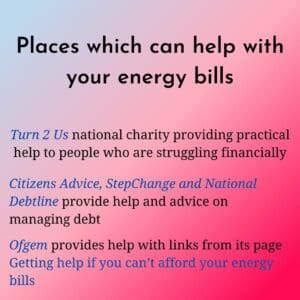 Ofgem provides help with links from its page Getting help if you can’t afford your energy bills. Its rules state that suppliers must work with you to help you if you are in financial difficulty.
This might include setting up a payment plan, payment breaks, more time to pay, access to hardship funds or providing details to the Priority Register. If you are vulnerable you should be on your supplier’s list.
There may also be access to hardship funds and grants from various other organisations. You may also be able to get 60 days’ space from creditors to focus on getting debt advice and setting up a debt solution.
You can also get debt advice from Citizens Advice, StepChange and National Debtline.
Go to Turn2Us who provide information and advice on what help is available including charities that will help you pay your bills.
In summary, if you are having problems talk to your energy supplier, they are obliged to help you! Keep everything in writing so you have the evidence should you need to take the matter further such as to the Energy Ombudsman.
Further help to complain
20 Tips for effective complaining

101 Habits of an Effective Complainer provides you with more tips.

Purchase and download templates to gain redress swiftly.
The Complaining Cow Consumer Show
I spoke to Sara Williams from DebtCamel about debt management and what consumers can do on on my East London Radio The Complaining Cow Consumer Show. She also advises on where not to go for help and what to avoid, especially scams.
*Affiliate link