
Energy Companies increase Direct Debits too much
On 3 May the Business Secretary, Kwasi Kwarteng announced that Ofgem will undertake a series of “market compliance reviews”. These are to include a “stricter supervision of how direct debits are handled” by suppliers. The Government announced that some energy suppliers were hiking the prices of Direct Debits by more than is necessary. In some cases customers are seeing double or even triple their previous monthly payments.
Ofgem has given energy companies three weeks to explain what they have been/are doing or face punishment. In the first instance Ofgem prefers to work with companies to bring a resolution to issues. However, it does have the power to fine companies, according to Ofgem’s Compliance and Enforcement website page.
Kwarteng has said “The regulator will not hesitate to swiftly enforce compliance, including issuing substantial fines.” It would be good to see these companies fined and the money put back into the pockets of consumers!
Ofgem chief speaks out
The energy price cap rose by 54% – or on average £700 – to £1,971 a year. They are expected to rise again in October.
Just two weeks after this rise, Ofgem’s chief executive, Jonathan Brearley, said the regulator was seeing “troubling signs” that some companies were allowing customer service levels to deteriorate, and that concerns were raised by consumers and consumer organisations that some energy companies “may have been increasing direct debit payments by more than is necessary, or directing customers to tariffs that may not be in their best interest”.
It would appear that energy companies are profiteering. Brearley has said that some suppliers have been using the extra money “to prop up their finances, enabling them to follow more risky business models”. He also said that “Customer credit balances should only be used to reconcile bills, not as a source of risk-free capital.”
Citizens Advice calls for action
Citizens Advice star rating research released on the 8 April 2022 showed that “energy suppliers’ customer service is the worst it’s been on average since 2017. It comes a week on from the rise in the energy price cap “. The research showed that time waiting on the phone and for responses to emails are on the increase.
If a consumer is struggling to pay their energy bills, suppliers are responsible for providing support, such as affordable payment plans. But Citizens Advice is concerned that “many could be missing out on help they’re entitled to because they’re unable to easily contact their supplier.”
The charity calls on Ofgem to “… introduce a ‘consumer duty’ to ensure suppliers provide a service specifically designed to meet the needs of all customers.” and adds that “A similar approach is being adopted by the Financial Conduct Authority to upgrade consumer protection. It should make companies directly responsible for the outcomes their customers experience. This includes making it easy to contact companies and get support when needed.”
The shocking customer service currently being provided adds to people’s worries about bills and demonstrates that energy companies are cutting corners and not investing in supporting consumers through this difficult time.
Check your energy bills
It’s easy to check your bills. Look at your previous bills and estimate how much you would expect to pay with the 54% rise. If you think the new Direct Debit amount is excessive then write to your energy company and complain. Ask it to lower the Direct Debit amount to a figure that you provide and include your own calculation. Then keep an eye on your consumption, taking a reading each month, so you don’t get any nasty surprises further down the line.
To calculate your bill: Take the price of electricity or gas per unit (KW/h) divided by 100 and multiply that by the consumption of the energy used. Add the cost of the standing charge, as the number of days multiplied by the daily charge, then add the VAT, which for energy is currently 5%.
So for example:
| 1) | Pence per KW/h/100 x consumption 18.5/100) x 315.5 | + | £58.37 |
| 2) | Days x daily standing charge 63 x 0.223 | + | £14.05 |
| 3) | Sub total | = | £72.42 |
| 4) | VAT @ 5% | + | £ 3.62 |
| 5) | Grand Total | = | £76.04 |
If you have a day and night rate, also perform the same check for the night rate.
If you have both electricity and gas then repeat the check for your gas bill too.
Check the reading
If your supplier has used estimated readings for a long time, it could be that your bill is significantly wrong. Take accurate readings and submit them to your supplier.
Don’t pay the estimated bill. Instead, send correct readings to your supplier who will provide an accurate bill. It could work in your favour, as you may have paid too much and be in credit. But do remember it could also go the other way!
Check the Direct Debit
Your Direct Debit amount should be the same each month/quarter and your supplier must inform you if it will change. If it doesn’t inform you, you can complain to your bank under the Direct Debit guarantee. The bank should then put you back into the position you were before the increase.
With these simple checks you can ensure that you stay in control of your energy bills.
Talk TV talking energy prices 01/10/22

Help with complaining about energy

How to save money on and complain about, energy various posts to help with all aspects of energy
Help with paying energy bills
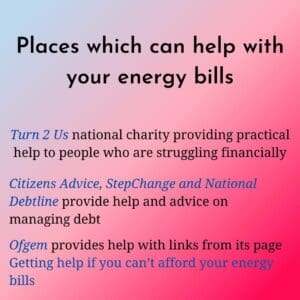 Ofgem provides help with links from its page Getting help if you can’t afford your energy bills. Its rules state that suppliers must work with you to help you if you are in financial difficulty.
This might include setting up a payment plan, payment breaks, more time to pay, access to hardship funds or providing details to the Priority Register. If you are vulnerable you should be on your supplier’s list.
There may also be access to hardship funds and grants from various other organisations. You may also be able to get 60 days’ space from creditors to focus on getting debt advice and setting up a debt solution.
You can also get debt advice from Citizens Advice, StepChange and National Debtline.
Go to Turn2Us who provide information and advice on what help is available including charities that will help you pay your bills.
In summary, if you are having problems talk to your energy supplier, they are obliged to help you! Keep everything in writing so you have the evidence should you need to take the matter further such as to the Energy Ombudsman.
Further help to complain about energy
20 Tips for effective complaining

101 Habits of an Effective Complainer provides you with more tips.

Purchase and download templates to gain redress swiftly.